
I’ve been thinking a lot about the unconscious lately. I’ve never been a big believer that there was a separate part of your mind called the unconscious. I always just felt like your mind is your mind, that it sometimes thinks this way, it sometimes thinks that way. But this book, Existential Kink, has me thinking otherwise.
One of the central ideas of the book is that if unexamined, the unconscious mind gets what it wants. If you want to know what your unconscious mind wants, just look around. So, for example, if you are always broke, your unconscious mind wants it that way for some reason. You unconsciously want to struggle, or you unconsciously are thrilled by the stress of anxiety that comes from scarcity. The idea is that if there’s a goal you have consciously but always seem to just fall short of, maybe your unconscious is sabotaging you.
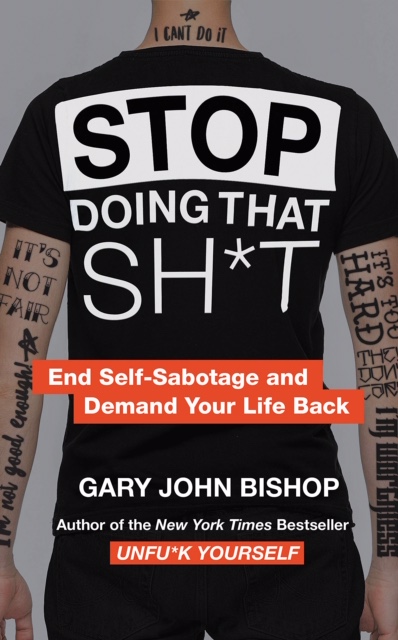
Which brings me to book number two. I haven’t actually “read” a Gary Bishop book, but I’ve listened to two of them. There’s something wonderful about his Scottish pragmatism. And the accent.
But, speaking of sabotage, Gary says we all have three saboteurs, three stories we tell ourselves, one about our selves, one about other people, and one about the world itself. And his point is these stories we tell ourselves are used as our identity, our belief system. So the story you tell about yourself might be “I’m no good.” One might argue that this may be a reasonable belief, that maybe you’ve done some shitty things in life, so therefore you’ve proven that you’re no good. Gary’s point is that you will unconsciously make sure to reinforce that you’re no good. You might be on your way to completing a project at work, but you’ll manage to fall just short, miss a deadline, misplace something, not gather your thoughts the night before a presentation then show up underprepared. All just to unconsciously reinforce your belief in yourself, to strengthen your identity.
In Existential Kink Carolyn Elliott repeatedly shares a Carl Jung quote: “Until you make the unconscious conscious, it will rule your life and you will call it Fate.” She argues, like Bishop, that if you are unaware of the story you unconsciously tell yourself, you will continue to perpetuate it. In fact, she argues, you will seek it out because you actually crave some portion of it. You “get off” on the thrill of anxiety, the rush of fear that comes from failing and being criticized.
Where does this leave me? Well, a few thoughts.
1) I’ve got my three saboteurs. I suck. People suck. Life is hard.
2) If, as Carolyn Elliott argues, you can tell what your unconscious wants by what you have, I want to not have sex, to have things pile up on me because I procrastinate, to not be in the kind of shape I think I want to be in. But, when I dive a little deeper, I think what my unconscious really wants is to suffer – to suffer so that I can then reach out to people (women) and have them reassure and comfort me. I guess I “get off” on receiving acceptance, comforting, nurturing from females. So, to get back to my first saboteur, “I suck,” so that I’ll be able to point to my suffering and receive comforting from women. I think my unconscious also causes me to procrastinate to the point that someone needs to give me a kick in the ass to get things done. This strengthens my identity of sucking, but it also fulfills another unconscious desire which is to have someone tell me what to do. (And speaking of “getting off” on our unconscious desires, this ties in nicely with a quite erotic sexting session I had recently where a woman took charge and told me what to do and had me sucking on her strapon before she fucked me with it. A story for another time perhaps.)
3) It’s one thing to figure out what my unconscious wants; but it’s a completely different task to figure out what it is my unconscious is keeping me from achieving when I can’t really pinpoint my conscious wants. I don’t know what it is I really want to achieve.
Here’s another thing: Existential Kink focuses primarily on the unconscious desires that are holding us back from something, those that are negative to our daily life. But there are unconscious desires that can be positive as well. For example, if you believe that your unconscious gets what it wants, my unconscious wants security and comfort. I have a great, steady job; I have a home; I have consistency and comfort in my life.
But I don’t have a clue what I want to pursue. I want to harness the power of the unconscious mind and use it in tandem with the conscious mind to reach heights I never believed achievable. If only I could figure out what mountain I was trying to climb.
 Sex And Depression